



Did You Know? Italy
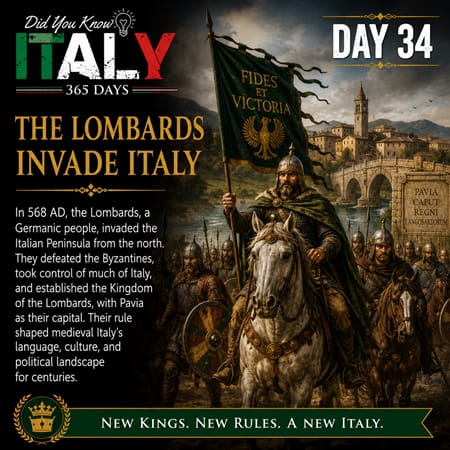
In 568 AD, a new Germanic people crossed the Alps and entered Italy.
They were the Lombards, and their arrival would shape Italian history for more than two centuries.
Led by their king, Alboin, the Lombards entered northern Italy after the peninsula had already been devastated by years of warfare between the Ostrogoths and the Byzantine Empire. They quickly captured important northern cities. In 568 AD Cividale del Friuli was the first major stronghold to fall. It became the seat of the first Lombard duchy. The Lombards continued moving west, and within a year they captured Milan. Three years later, the city of Pavia fell after a grueling three-year siege. The Lombards eventually established their capital at Pavia, which became one of the most important cities in medieval northern Italy.
Unlike the earlier Ostrogothic kingdom, the Lombards didn’t initially control all of Italy. The Byzantine Empire retained territories along the Adriatic coast, Rome, Ravenna, southern Italy, and parts of central Italy.
The result was a divided peninsula.
This division would have enormous consequences. Italy would remain politically fragmented for centuries, with Lombards, Byzantines, popes, local rulers, and later powerful city-states competing for territory.
Their influence wasn’t limited to politics. Over time, Lombard traditions mixed with Roman and Christian culture. The Lombards converted to Christianity, sponsored monasteries, and became an important part of Italy’s developing medieval civilization.
Their kingdom finally came to an end in 774, when Charlemagne conquered the Lombard Kingdom and assumed the title “King of the Lombards.”
But the Lombards left their mark.
Their name survives in Lombardy, the prosperous northern Italian region that includes Milan, Lake Como, Bergamo, and other historic cities.
The Lombards are a perfect example of how Italy’s history is layered. Beneath the modern Italian nation are centuries of different peoples who settled, fought, traded, married, and eventually became part of the culture of the peninsula.
Did you know that the Italian region of Lombardy gets its name from the Lombards?
Related Articles:
Join us every day as we explore a fascinating fact, untold story, or remarkable piece of Italy’s history and culture. Whether your family came from Italy, you’ve traveled there, or you dream of visiting one day, this year-long journey is your daily passport to the heart of Italy. You can follow us on Facebook, Instagram or X (formerly Twitter). You can subscribe for free by filling out the form below to get it sent to your email.
Discover more from Molto Italiano
Subscribe to get the latest posts sent to your email.